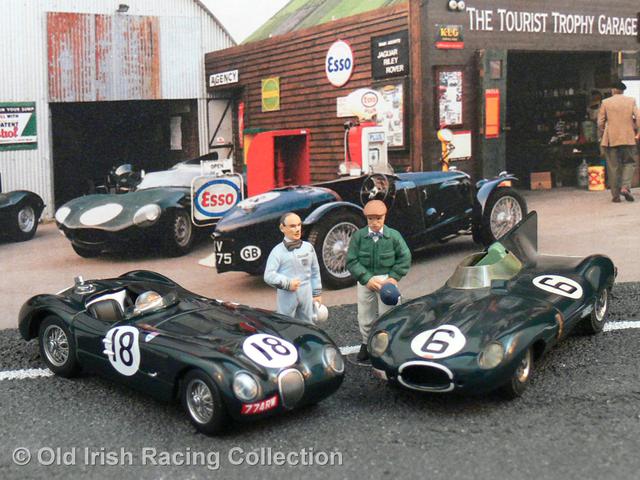
Welcome to the Old Irish Racing Collection

Your hosts Mike and Stirling will guide you through the Old Irish collection of Jaguar, Ferrari, Alfa Romeo, Porsche, Austin Healey, Lotus, Aston Martin, BMW, Porsche, Mercedes, Racing and Sports cars and other various marque models we have collected through the years and are the most passionate about. Be sure to visit the Drivers Hall of Fame! We start the tour with the Jaguar race cars from the 1950's thru the 1970's.

Click on any photo to see a larger image of the model in our collection. Your tour will start with our Jaguar Racing collection. To go to another collection room, please select from one the links at the bottom of each page. Enjoy!

JAGUAR RACING TO 1980:

1950's - The C & D Types
1950 XK120: NUB 120 was well driven by Ian and Pat Appleyard to 1st place in the 1950 Alpine, 1951 Tulip, Alpine & RAC rallies. Pat Appleyard was the daughter of Jaguar founder, Sir William Lyons
Model by CORGI 1/43
1951 XK120-C (C-Type): Driven by Peter Walker and Peter Whitehead to Jaguar's first Le Mans victory in the 1951 race. The heart of the tubular chassis and aluminum skinned C-Type is the 3.4L twin-cam, straight-6 engine, tuned to produce around 205 bhp.
Model by IXO 1/43
1953 XK120-C (C-Type): Jaguar's second LeMans victory came as a result of the efforts of Tony Rolt and Duncan Hamilton in this car in the 1953 race. They finished with an average speed of 105.85 mph.
Model by AUTOART 1/43

1953 XK120-C (C-Type): Later C-Types such as this one were more powerful than the earlier cars, using triple twin-choke Weber carburetors and high-lift camshaft. They were also lighter and better braked, by means of all-round disc brakes.
Model by TOP MODEL 1/43
1953 XK120-C (C-Type): Jaguar finished 1st and 2nd at LeMans in 1953. The last LeMans outing for a C-Type was in 1954 when the French entry finished 4th.
Model by AUTOART 1/18
1953 XK120-C (C-Type): The C-Type was produced from 1951-53 and 54 cars were made for factory and customer teams. The C-Type was about 1,000 pounds lighter than a stock XK120.
Model by AUTOART 1/32

1953 XK120-C (C-Type): Roy Salvadori won at Goodwood in 1954 driving this Ecurie Ecosse C-Type.
Model by JAGUAR MODEL CLUB 1/43
XK120-C (C-Type)
Models by AUTOART 1/43, 1/32, 1/18
1953 XK120-C (C-Type): Roger Laurent and Charles de Tornaco drove to 9th place in the Ecurie Francorchamps entry at Le Mans in 1953. Jacques Swaters owned the team and he would drive this car again in 1954 at Le Mans with Laurent to 4th place.
Model by IXO 1/43

1952 XK120-C (C-Type): Stirling Moss co-drove this car with Norman Dewis in the 1952 Mille Miglia. It was the first endurance test for the new disc brakes on the C-Type and while in the lead. Moss hit a boulder on a mountain road only 123 miles from the finish while in third place. The steering broke and that was the end of the race, but not of the development of what had been proven to be a superior braking system to customary drum brakes!
Model by BRUMM 1/43
XK120-C (C-Type): Even one in pewter! The C-Type was designed and developed for one purpose and that was to race an win Le Mans, a feat it was to do twice, while always being one of Jaguars best of a long line of memorable race cars. If I had to choose one, a C-Type would probably be the Jaguar race car I would most like to own, bags of fun to drive!
Model by DANBURY MINT 1/43

1954 D-Type: The D-Type was produced purely for competition. The D-Type used the same 3.4L engine as the C-Type, although it was later increased in capacity to 3.8L. Introducing the monocoque chassis, which not only introduced aircraft-style engineering to competition car design, but also an aeronautical understanding of aerodynamic efficiency. One, if not the most beautiful race cars of all time! This is OVC 501, the factory prototype.
Model by AUTOART 1/18
1954 D-Type: Not all D-Types had fins. I made this model years ago as a boy in the 60's to replicate the 1954 LeMans car of Moss and Walker (which did have a fin.) Building this model is when I probably first got hooked on Jaguars. The rest as they say, is history!
Model by STROMBECKER 1/24
1954 D-Type: From the beginning, the D-Type had great racing success. This car finished second at the 1954 LeMans with Hamilton and Rolt, just narrowly missing a repeat win for both themselves and Jaguar.
Model by CARRERA 1/32

1954 D-Type: The first Jaguar win with the D-Type came at Reims, with Peter Whitehead and Ken Wharton teaming up to win the 12 hour race in OKV 3 (XKC 404).
Model by AUTOART 1/12
1955 D-Type: Mike Hawthorne and Ivor Bueb drove to first place in the 1955 LeMans race amidst the tragedy that claimed many spectator lives and the subsequent Mercedes team withdrawal from the race while leading. Jaguar also finished third in that race. (XKD505)
Model by QUARTZO 1/43
1955 D-Type: Bill Spear and Phil Walters finished 7th at the 1955 Lemans driving the Briggs Cunningham entered D-Type (XKD507).
Model by WESTERN 1/43

1955 D-Type: The Hawthorne/Bueb 1955 LeMans winner.
Model by WESTERN 1/43
1955 D-Type: The Scottish team Ecurie Ecosse entered their car (XKD501) alongside the factory team entries at LeMans in 1956. Attrition took the factory team out of the race, but the D-Type of Ron Flockhart and Ninan Sanderson prevailed to take first and a tremendous win for the Ecosse team.
Model by IXO 1/43
1956 D-Type: Using an ex-works D-type (XKD 606) prepared at the factory, Ecurie Ecosse once again finished first with the team of Ron Flockhart and Ivor Bueb at the wheel. Jaguar had stopped its factory racing program, but was actively supplying cars and assistance to private teams. It was Jaguar's year, as six D-Types finished in the top seven places.
Model by IXO 1/43

1955 D-Type: Another version of the Cunningham D-Type. Cunningham would come back to LeMans with Jaguars in the 1960's. Cunningham campaigned significant Jaguars beginning with this car, followed by the E2A and then the lightweight E-Types.
Model by IXO 1/43
1955 D-Type: Ecuire Ecosse entered the same car (XKD 501) they used to win LeMans in 1956, in the 1957 Mille Miglia driven by Ron Flockhart. Unlike at LeMans, the car did not finish.
Model by CARRERA 1/32
Jaguar D-Type: 1957 was the high watermark for D-Types. While they continued to race at LeMans until 1960, they did not achieve the same success and regulations had reduced displacement to 3 liters. In the end, 53 customer D-Types and 18 factory cars had been made before a fire at the factory in 1957 ended further production.
Models in various scales

1956 D-Type: This car (XKD606) is one of the ex-works cars prepared for Ecurie Ecosse to race at Le Mans in 1957. A long-nosed version, it was the back-up works car at Le Mans the prior year. A built kit of the 1957 LeMans winner.
Model by PROVENCE MOULANGE 1/43
1955 D-Type: This is another version of the 1955 LeMans winner, this time a 1/32 scale slot car. Most of the 1/32 scale cars in the collection are functioning slot cars we race on our track here at Old Irish Racing.
Model by AUTOART 1/32
1955 D-Type: Equipe Nationale Belge entered this car for Belgians Paul Frère and Freddy Rousselle, who finished 4th behind three other D-Types at Le Mans in 1957. Frère would win at Le Mans in 1960 driving for Ferrari. He was later a successful author and journalist. His 1963 book, Sports Car and Competitive Driving is still a standard reference in the field. It influenced the development of competition driving schools, such as those founded by Jim Russell, Bob Bondurant, and others.
Model by ALTAYA/IXO 1/43

1956 D-Type: The Jaguar factory effort at Le Mans in 1956 failed to produce a victory to repeat their success of a year earlier. Mike Hawthorn and Ivor Bueb suffered from a broken fuel line in this car (XKD605) while leading the race, costing them 22 laps and a chance to repeat as Le Mans winners for Jaguar, finishing a disappointing sixth. Hawthorne did set fastest lap of the race
Model by BRUMM 1/43
1956 D-Type: The Paul Frére and Desmond Titterington's race was over by lap three in this car (XKD603). Frére spun in esses in heavy rain, on the slick, newly resurfaced track. He was then hit in the rear by the Ferrari of de Portago. Ironically, XKD603 was the spare car, due to Titterington having wrecked the original entry (XKD606) in practice. This pair was a dismal 0-2 with D-Types at Le Mans in 1956.
Model by BRUMM 1/43
1956 D-Type: Jack Fairman swerved to avoid the spinning Frére in the esses and as a result, his car shared with Ken Wharton (XKD602) made a hasty exit from the race on Lap 3 as well. Ecuire Ecosse ultimately saved the day for Jaguar in 1956, but this would be the last official Jaguar works entry of the D-Type in competition.
Model by BRUMM 1/43

1955 Jaguar D-Type: The 1955 Le Mans winning D-Type.
Model by SPARK 1/24
Jaguar D-Type: Model D-Types have been made almost since its introduction. This one is from the 1960's.
Model by SOLIDO 1/43
Jaguar D-Type: You can never have too many D-Types!
Model by DANBURY MINT 1/43

1956 MK VII: Ronnie Adams and Frank Biggar drove this car to a 1st place victory on the Monte Carlo rally in 1956. Big Jaguar saloons were used with great success on both rallies and in saloon car racing in Britain. The Mk VII used the 3.4L XK engine, producing 190 bhp and despite its size, could produce a top speed of over 100 mph.
Model by OXFORD 1/43
1958 3.4: The small Jaguar Saloons such as the 2.4 and 3.4 made their way into competition, particularly rallying. With mild factory support, thirty cars were entered by private teams. This is one of them from the 1958 Monte Carlo rally.
Model by ELGIOR 1/43

Ecurie Ecosse Commer Transporter: In 1959, Ecurie Ecosse commissioned this transporter to be built to haul their cars from race to race. Too late for D-Types, it would have hauled the teams Tojeiro-Jaguars and Cooper Monacos.
Model by CORGI 1/43
Ecurie Ecosse Commer Transporter: At the time, it was considered to be a state of the art transport for three team cars, with crew quarters, work area and stores. It survives and is used regularly at vintage racing events.
Model by SPARK 1/43

1960's - The Mk2's & Touring Car Domination
1960 Mk2 3.8: Bernard Consten and Jack Renel drove their Mk2 to a 1st place finish at the 1960 Tour de France. While Jaguar was not actively racing, they did maintain a competitions department, which assisted private teams such as Consten's (and with good result!) This car was factory prepared.
Model by IXO 1/43
1960 Mk2 3.8: The pair of Consten and Renell teamed up once more and again won the Tour de France in 1961. France was/is a big market for Jaguar and success in the Tour, while not as prestigious as LeMans, was very important for Jaguar none the less.
Model by VITESSE 1/43
1960 Mk2 3.8: Another version of the 1961 TdF car of Consten/Renell. Bernard Consten won four successive Tours for Jaguar in his famous white cars.
Model by VANGUARDS 1/43

1960 Mk2 3.8: With its 3.8 six-cyl. engine, the Mk2 was a powerful competitor in sedan racing in the early 60's, picking up where the 3.4L Mk1 left off. Private teams such as Equipe Endeavor which entered this car in the 1961 Silverstone race for Jack Sears, had great success for Jaguar in the British Saloon Car Championship (later BTCC) where the Mk2 dominated. Sears finished second in this race on the GP weekend.
Model by CORGI 1/43
1960 Mk2 3.8: Probably the most successful private team racing Mk2's, was that of John Coombs. Coombs incorporated race-proven engineering modifications that made the 3.8 liter MKII sedan not just considerably faster, but smoother, less stressed, and totally reliable. Documented Coombs cars are much sought after today. This car BUY 12, is one of the most famous and was driven by Hill, Salvadori and others to many wins.
Model by VITESSE 1/43
1960 Mk2 3.8: Tommy Sopwith's Equipe Endeavor employed Stirling Moss to drive their Mk2 entry at the Goodwood TT race prior in 1960 (first race for the Mk2). Moss finished 2nd to Salvadori in a Coombs Mk2, in what was a great rivalry between the two teams for the 1960-62 seasons. Moss would retire from racing in 1962, following a terrible accident and this was his last competition drive in a Jaguar before retirement.
Model by DEL PRADO 1/43

1964 Mk2 3.8: Down under, touring car racing was just as popular as it was in Europe. Bob Jane was the great Aussie driver of Jaguars in the 60's who dominated all competition. Jane was successful in developing his cars to produce maximum performance and handling (over 300 hp!) and is truly a legend in Jaguar racing.
Model by SCHUCO 1/43

1960's - The E-Type Era
1960 E2A: The E2A was created by Jaguar as a racing prototype which bridged the gap between the D-Type and the E-Type. There were new elements such as IRS and aluminum 3.0L engine to meet current regulation, producing close to 300 bhp, which distanced it from the D-Type. Briggs Cunningham entered the Car at Le Mans and Dan Gurney and Walt Hansgen drove. Fuel injection woes sidelined the car, but not before Gurney turned the fastest lap.
Model by MERIT/HYMAN 1/24
1960 E2A: After Le Mans, Cunningham brought the E2A to America for the racing season here and fitted with a larger 3.8L engine. Although it won at Bridgehampton, the E2A was not designed for most shorter USA sprint races. Jack Brabham drove the E2A at Riverside to 10th place where he did a creditable job of making the heavier E2A competitive gainst the lighter weight competition. Bruce McLaren drove the car in its last race at Laguna Seca, where he could only manage 12th.
Model by CONTACT 1/43
The E2A model here was built from a Merit D-Type kit and modified by a young enthusiastic teenager named Art Hyman when the E2A was new. I had the opportunity to buy the model from Art recently and his work of over 50 years ago is being preserved in our collection not only as a tribute to the car, but as a tribute to Art, a great auto and racing enthusiast!

1961 E-Type OTS: Roy Salvadori drove this car to a creditable 4th place at the Goodwood Tourist Trophy race in 1962, behind three Ferrari GTO's. Owned by John Coombs, it is the prototype of the lightweight E-Types and employed alloy panels, center section and top. Graham Hill was the principal test driver of the E-Type race cars, but drove Coombs GTO (2nd) in the TT race.
Model by BEST
1961 E-Type OTS: Equipe Endeavor, along with Coombs, were the first teams to embark on racing the E-Type in basically production trim. ECD400, one of the most famous racing E-Types, was entered for Graham Hill at the 1961 Brands Hatch where Hill finished in 3rd place. It was common for the top drivers of the day to race in supporting events and series between F1 races. Hill did much of the development testing on the racing E-type.
Model by CORGI 1/43

1961 E-Type OTS: Ken Baker drove his E-type (7CXW) to many wins in club and minor races In England. He is considered the most successful E-Type club racer in the UK. He also did well against stiff competition such as the factory Aston Martin effort beating them at Oulton Park in '62.
Model by CORGI 1/43
1962 E-Type FHC: The John Coundley/Maurice Charles FHC was also entered as a private entry by Charles at LeMans in 1962. Unfortunately, poor preparation resulted in a DNF, described by Coundley as the worst racing experience of his life.
Model by BEST 1/43
1962 E-Type Lightweight FHC: The introduction of the E-Type brought Jaguar back to sports car racing with a true GT car. As with saloon car racing, factory support and assistance was given to select teams. Briggs Cunningham was one such team. The Cunningham and Salvadori driven coupe finished in 4th place, a heavily modified FHC developing 296 hp, it was a precursor to the light weight cars yet to come.
Model by BOX 1/43

1962 E-Type Lightweight FHC: Another more detailed version of the Cunningham coupe from Le Mans in 1962.
Model by KYOSHO 1/43
1962 E-Type OTS: The introduction of the E-Type caught many toy makers fancy and it appeared in many variations, sizes and materials. This is a vintage slot car from the 1960's.
Model by Eldon 1/32
1963 E-Type OTS: While it was possible to remove the hardtop of the E-Type Lightweights, I am reasonable sure it was never done. This model is more a result of a manufacturer using up pieces from prior models and redressing a prior release. A nice model in its own right, it bears the LeMans racing number and colors of one of the Cunningham Lightweights from 1962 and right now fills that gap in my collection.
Model by BBURAGO 1/18

1963 E-Type Lightweight: In early 1963 Jaguar announced the 'Competition E', which quickly also became known as the "Lightweight E-Type". Twelve were constructed and three went to Briggs Cunningham and all were entered at LeMans. E-Type 850659 is one of those cars and this is how the car looked as it raced at LeMans in 1963 and despite an accident, it finished 9th with Bob Grossman and Briggs Cunningham.
Model by BEST 1/43
1963 E-Type Lightweight: The Lightweights were constructed with aluminium monocoque , alloy engine block and fuel injection. Power from the 3.8L engine was 300 bhp. While LeMans was a poor showing by the team, the Cunningham cars had class wins at Daytona, Sebring and Road America
Model by REVELL 1/32
1963 E-Type Lightweight : The hope of Jaguar, was that the Lightweight E-Types would successfully challenge the GTO Ferrari's at LeMans. Attrition and the tendency of the front end to lift at speed cut short those hopes as the remaining car struggled to finish, three GTO's finished ahead of the Grossman/Cunningham car. This car driven by Roy Salvadori and Paul Richards failed to finish due to an accident in the 6th hour.
Models by BEST 1/43

1963 E-Type Lightweight : Chassis No. S850660 was the third lightweight built of twelve and delivered to Kjell Qvale the West Coast distributor for Jaguar. It was raced at Sebring where it finished 7th OA and first in class with Ed Leslie and Frank Morrill driving. Shortly after the 1963 race season, the car was sold and disappeared until 1999 when it was "rediscovered" having sat for 35 years in a garage under boxes, with only 2,663 miles since new.
Model by Revell 1/32
1964 E-Type Low Drag Coupé : The first Lightweight E-Types were roadsters fitted with a hardtop, which wasn't the most aerodynamic. For the 1964 Le Mans race Jaguar engineer Malcolm Sawyer developed a new coupe body designed by Dr. Samir Klat, specifically designed for the long straights. These 'Low Drag Coupes' featured a completely new rear end, and also a slightly revised nose. This car was raced at Le Mans in 1964 by Peter Lindner and Peter Nöcker, however they retired in the 16th hour with a blown head gasket.
Model by Revell 1/32

Models by Revell 1/32

1966 XJ13: The XJ13 was designed to race at LeMans. However, before it could be constructed, regulations changed and the XJ13 was rendered obsolete for its intended purpose against the 7.0L GT40 Fords.. Only one car was built and it was almost destroyed in an accident during the filming of a publicity film for the introduction of the V12 E-Type in 1971.
Models in 1/64 (HOTWHEELS) & 1/43 (DINKUM)
1966 XJ13: The aluminium body was designed by Malcolm Sayer, the aerodynamicist responsible for the Jaguar C-type, D-type, E-type and XJS. The prototype was tested at MIRA and at Silverstone, which confirmed that it would have required considerable development to make it competitive. The prototype was put into storage and no further examples were made.
Model by DINKUM CLASSICS 1/43
1966 XJ13: The XJ13 had mid-engine format with the 5.0 litre V12 engine mounted behind the driver, used as a stressed chassis member together with the five-speed manual ZF Transaxle driving the rear wheels. The engine design was essentially two XK 6-cylinder engines on a common crankshaft with an aluminium cylinder block, although there were differences in the inlet porting, valve angles and combustion chamber shape.
Model by AUTOART 1/18

1970's - The Cat is Back!
1970 XJ6 S1: This car was driven in the Jaguar Enthusiasts Club (JEC) Saloon Championship in 2005 by Carl Gannon, one of the foremost experts on Jaguar saloon car racing along with his partner Nick Gwinnutt. The Series 1 XJ6 ('68-'73) is powered by a 4.2L twin-cam engine, producing about 245 hp. Its nice to see this old crocks still actively racing. The cars too!
Model by VANGUARDS 1/43
1974 XJ12 S2: Not a race car, but actually a fire tender from the Silverstone circuit. Jaguar has supplied cars for use with specially mounted water tanks and fire equipment to allow rapid response to incidents that may occur during races there. This is the 12-cyl. (5.3L) version of the XJ.
Model by VANGUARDS 1/43
1976 XJC: The 5.3L coupe was a natural candidate for racing and given sufficient resources and development, would have lived up to its demonstrated potential, as the car took many poles, but usually failed to finish. In race trim, the 12-cyl. produced over 560 hp! Raced with British Leyland sponsorship, the XJC was developed, prepared and raced by Broadspeed for the ETCC series in 1976 & 77. This car was entered in the 1977 RAC Tourist Trophy at Silverstone where it spun on oil ten laps from the finish while leading. Andy Rouse was the pilot at that race, as he was throughout the program. A sister car ran at most races as well, team drivers being Derek Bell, John Fitzpatrick and Tim Schenken. Their best result for the team was a second place finish at Nurburgring for Rouse and Bell.
Model by SMTS 1/43

1974 E-Type V12 SIII: At the same time Bob Tullius and Group 44 were developing their E-Type for SCCA BP racing on the E. Coast, Joe Huffaker was preparing a car on the W. Coast. With Corvette as the main competition, each car won its respective region and met up in the SCCA finals in 1974 & 75. Group 44 got the upper hand both times, but I watched this 450+ hp car being driven by Lee Mueller, race several times those years and if not for a flat tire the first go round in '74, I think they would have split the Championships.
Model by PROVENCE MOULAGE (factory built) 1/43
Champions!
Models by PROVENCE MOULAGE 1/43
1974 E-Type V12 SIII: This is the 5.3L V12 powered E-Type that Bob Tullius drove to the SCCA National Drivers Championship in B Production in 1975 and was runner-up in 1974. If the tires had not started to go away, the big cat would have won both years. As with the Huffaker car, Tullius had modest Jaguar support for the Group 44 racing effort. From here for Tullius, it was on to the SCCA's Trans Am for 1976 in the new XJS and ultimately IMSA and Le Mans in the XJR5.
Model by PROVENCE MOULAGE 1/43

1978 XJS: In 1976 Group 44 began developing and racing the XJS in the U.S. IMSA series. Coming off 5 victories in the '77 season, in '78 the team won 7 more, Tullius won the drivers title and the manufacturers championship for Jaguar. Powered by 560 bhp, 5.5L V12, the XJS outgunned the Corvettes all season long.
Model by ALEZAN (kit) 1/43
1970's Jaguar Vintage Racing Transporter: I think this model truck came from Denmark a number of years ago. I found it on eBay and because it had Jaguar on it, I had to have it. I have not seen another like it since. Any information on maker, or if this represents an actual team would be appreciated.
Model by UNKNOWN 1/43

Click here to continue on to JAGUAR RACING (1980 on)

To continue to another collection room or to go back, select one of the following:
JAGUAR RACING Pre-1980
JAGUAR RACING (1980-1990)
JAGUAR RACING (1991 on)
JAGUAR PRODUCTION CARS to 1979
JAGUAR PRODUCTION CARS from 1980
FERRARI
PORSCHE RACING
AUSTIN HEALEY
ALFA ROMEO
MERCEDES W196 & 300SLR
RACING CARS to 1969
RACING CARS from 1970
SPORTS & GT CARS
PRE-WAR to 1950
THE LEGENDS OF RACING HOF
THE RACING ROOM
NEW MODELS & RESTORATION

The Jaguar Scale Model Collectors are on Facebook CLICK HERE to go to there.

For copies of images, questions or comments about the collection to: OLD IRISH RACING

Back to: OLD IRISH RACING

Member of International List of Scale Model Related Web Sites